Category Archives: Worship
Click here to view worship announcements
Church. What is it Good For?
Remember the 1970 song, War, made famous by Edwin Starr? It had the famous lyric, War! What is it good for . . . absolutely nothin! It became a rallying cry for many opposed to the war in Vietnam and a divisive song for a country torn by that conflict. Today, many ask the same question about church . . . what is it good for? Some would say, absolutely nothing, thus the steady decline in church membership. Even the prophet Isaiah had some pretty scathing remarks too about how “church” is done. Come join us Sunday as we explore the first chapter of Isaiah and try to answer the question, Church . . . what is it good for? See you Sunday!
You can see Edwin Starr singing War on the following YouTube clip:
What’s In Your Barn?
“Greed is good“. This is a quote from Gordon Gekko from the film “Wall Street”. Or at least I thought it was. Come to find out, this is what he actually said in the film:
“Greed, for lack of a better word, is good. Greed is right. Greed works. Greed clarifies, cuts through, and captures, the essence of the evolutionary spirit. Greed, in all of its forms; greed for life, for money, for love, knowledge, has marked the upward surge of mankind and greed, you mark my words, will not only save Teldar Paper, but that other malfunctioning corporation called the U.S.A.”
Come worship with us this Communion Sunday as we explore what Jesus has to say on this topic in Luke 12:13-21 and share in the communion of our Lord. Hope to see you Sunday!
“Say What” – July 28, 2013
Say What? Sermon July 28th, 2013
Hosea 1:2-10
“Let the words of my mouth . . . “
According to the papers, it was not hard to catch ski-mask wearing Floyd Brown while he robbed a Holiday Inn in Anchorage, Alaska. Forty police officers were in the lobby of the hotel attending a law-enforcement training conference, which ironically, was advertised on the huge neon sign out front.
Closer to my hometown of Richmond Virginia, a young man was arrested after he was found screaming in a car that did not belong to him. Apparently his hand had gotten stuck in the dashboard when he tried to steal the stereo, and he was forced to cry for help through the pain of three broken fingers.
Both of these unfortunate individuals are in the running for the “not so prestigious” Darwin Awards. Named in honor of Charles Darwin who developed the theory of natural selection, the Darwin Awards commemorate those people who improve our gene pool by removing themselves from it, usually doing so in an extraordinarily stupid manner.
And though I never won this award, I must admit that I too have done a couple things in my lifetime that would have at least qualified me for honorable mention. One of my most embarrassing came when I was a senior in high school working on my neighbor’s farm. I was working by myself in a barn building a stand for a tank that would then be mounted on a trailer to use for spraying. I was using an acetylene torch to cut a piece of metal that was going to be used for the frame. Lost in my work I began to notice a burning smell. I turned around and realized that a piece of hot, cut metal had caught some loose hay on fire and was starting to burn. I quickly put this out and was pleased that a larger incident was averted. Feeling confident with my luck and with my piece of metal cleanly cut, I now needed to bend it upwards so that it could hold the tank. Not wanting to wait for help, I decided that I would just use a hammer to bend the heated metal. One hit . . . two hits . . . I think you might be able to see where this is going . . . three hits . . . and then BAM . . . the hammer clanked off the metal bar and hit me right in the head. Just like a scene from the 3 Stooges. Needless to say, I waited for help before finishing the job while deciding that “what happens in the barn can just stay in the barn”! Well, another potential candidate for the Darwin Awards comes to us this morning from our scripture passage.
Had CNBC or FoxNews existed in 8th century BCE Israel, you can almost hear the headlines . . . “Crisis in Religion . . . Hosea, a prophet to the nation of Israel, has been ordered by God to marry a prostitute . . . is this the end of Religion as we know it!” Pretty dramatic stuff. And yet we have to wonder, what was God and or Hosea thinking? At a time in history when the purpose of marriage was for the production of legitimate children to carry on the family name, why in the world would Hosea marry a prostitute? Is he becoming a candidate for a Darwin Award or is something else at work here?
The 1st chapter of Hosea which we read this morning is not a biography, but is rather an interpretative retelling of Hosea’s marriage to Gomer and the birth and naming of their three children. The traditional take on Hosea is that he was an 8th century prophet who was calling Israel to repentance and reform in the religious sphere . . . a turning away from the worship of Baal. But was it just the religious sphere that Hosea was concerned about or was it more than this?
One of my favorite radio programs used to be the late Paul Harvey’s “The Rest of the Story”. On this program, Harvey, with that wonderful distinct voice of his, would skillfully weave a narrative that would connect something that you were familiar with in the present to an event in the past. When he was finished you would have this connection that would make you go “wow . . . so that is how that came to be.” In our story this week, a voice that is missing that might be helpful in providing us some insight into the life of Hosea is from his wife, Gomer. If you all will allow me some literary license, I would like to share a letter that, if she were alive today Gomer might have written to us as a reflection on her life.
Gomer’s Letter:
Dear friends of St Croix Reformed Church. It is with both joy and pain that I share with you from the story of my life. As you probably know, Hosea and I lived in a very tumultuous time. Our country of Israel was going though Kings just as fast as we could produce them. One would take power and then would quickly die in some dramatic fashion . . . usually by assassination. Eventually our country was overtaken by the Assyrians and we had to flee with our family to the South. Fortunately, we were able to resettle and I do have joyful memories of my children marrying but as many of you may know, it is always sad to leave one’s place of birth. But, I am getting ahead of myself.
First, to set the record straight, I was not always a prostitute. In fact, the translation in your Bible might be more accurate if it read, “one who is prone to be promiscuous”. Maybe it would be better to say that “it was in my nature”, but that was not who I was. Hosea and I were married when I was just 16. I was still living at home with my father, mother, and 3 siblings. Hosea was working in the city as an established baker. He would get grain from area farmers and would provide bread for the village and the royal court. I think that this was where he first began to see problems with our country. But again, I am getting ahead of myself.
You must remember that marriage in our day was much different than marriage today. While we might fall in love, we did not marry for love. Marriages were about extending the family unit by providing heirs for the transfer of property. Hosea approached my father; a deal was struck; a dowry delivered; and we were married. It all happened so quickly, I can barely remember it. But I do remember our wedding night because having never been with a man I was both nervous and excited about starting our family. And it did not take long. Within our 1st year of marriage, our 1st son was born. This is when life for me with Hosea began to change.
Generally, when naming a child, a positive name is given. As far as I know, it is a tradition that goes back forever. In fact, you all do similar things today. Noah means “Rest or Peace”; Benjamin is “son of my right hand”. But when it came time to name our son, what does Hosea say . . . “Jezreel”! While it sounds pleasing enough and means “he sows” it is a name with a bloody history for it refers to a location in the Israeli countryside where an extremely bloody battle for power took place. It would be like naming a child born immediately after your Civil War “Gettysburg” . . . everyone would know what this meant. “Why”, I asked, and Hosea said that those currently in power took it through a bloody coup. Now, they were not being faithful to the covenant that the God of Israel had established. They were taking the money earned by the farmers and laborers and filling their own coffers. They were neglecting the poor, the widow and the orphan. Hosea said that when they heard the name Jezreel, they would realize that they needed to change their ways. Unfortunately, they did not listen.
When our second child was born, I was so excited to have a daughter. I know that sons are important, but I had such a good relationship with my mother that I was excited to share the same with my very own daughter. I would teach her to cook, and to weave, and would share with her all of the stories from our tradition. But when it came time to give her a name, Hosea cried out, “her name is Lo-Ruhamah”. My heart sank. In your language, Lo-Ruhamah is often called “No Pity”, but it is probably better translated “Not Motherly Loved” or “Neglected”. Hosea said that God was no longer going to have pity on Israel for what they had done. I said that I did not care what God thought or what the King and his royal court had done, how can I call my daughter “Not Motherly Loved”: a daughter that I loved more than life itself? I was screaming and crying . . . but Hosea was silent. For months I cried myself to sleep. I cried until the tears stopped coming and I just felt numb. All of the dreams that I had for my daughter were dashed again and again every time I said her name.
When our third child was born, the excitement from the previous births was over. Hosea said that this boy would be named Lo-Ammi which in your language means “Not My People”. Hosea said that the covenant with God was over. After the Exodus, when Moses spoke to God in the burning bush he asked God, “what shall I tell the people your name is”? God replied “I am”. Now, whenever anyone uttered the name of our son, it would remind them that “you are no longer my people” or “not, I am to you”. It was over. It was over with God and Israel, and it was over with me and Hosea. I was mad. I was mad at the God of Israel, mad at Hosea, and mad at the King. So, as soon as Lo-Ammi was weaned, I took matters into my own hands and I left.
Where did I go? I left for the temple of Baal. In the preceding year, an extremely long drought had overtaken the land and grain was scarce. Because of the Royal policies that Hosea had been complaining about, those in power were taking it all and there was not enough grain available for the farmers and the working class. As a result, people were starving. It was an awful time. Baal was the storm God who controlled the rain. Our annual ceremonies were performed in the temple so that Baal would return and bring the rain. If I could worship as a temple prostitute, could participate in the rituals of old, then maybe, just maybe, we would get the rain that we so desperately needed so that grain would be available to feed the starving. Additionally, it would help me forget. Forget the names; forget the pain; forget Hosea; forget it all.
I will spare you all the details, but the rain did not come and I could not forget. Because I was now an adulterer, by law I was chastised and eventually taken to be sold at auction as a slave or servant. When the day of the auction came, it started off like any other day for the past 12 months . . . hot, dry, and dirty. It was just as I felt. Dirty for what I had done and dirty for what I was becoming. When it was my turn to stand on the auction block, clouds started rolling across the horizon. At one point, I thought I heard thunder but knew it was probably in my imagination. Then, out of the corner of my eye I saw him . . . Hosea. He was here! And not only was he present, he was bidding for me! When it was over, he was the one who paid the price for my freedom. He had taken the meager money that we had saved and bought me back. I was both happy and ashamed. After he paid the money he came to me. My clothes were tattered and I was scared. What would he say? He put his arms around me and simply said “I love you”. It was too much for me and I just broke down and cried. And as we stood there in our embrace, weeping tears of joy, it started to rain.
That is my story. Hosea’s prediction came true and our country eventually fell. We fled to Judah to raise our family and as you know, Judah eventually fell as well. But though it all, God has stayed true to the covenant. During the Babylonian captivity; though the return and rebuilding of the temple; and through Jesus his son and beyond. Thank you for listening to my letter. Gomer.
P.S. Remember those awful names? As a sign of God staying true to the covenant with Israel and Judah, Hosea changed them. Jezreel really is “God Sows” for God’s people are everywhere; Lo-Ruhamah is now just “Ruhamah” for God will show pity and compassion on the World; and Lo-Ammi is just plain Ammi, for we all are God’s People!
“And now you know the rest of the story”. But in reality, this story continues. As I struggled with this passage this week I truly wondered, “Why would God command Hosea to marry a prostitute? What would be the purpose in that?” Then I realized that Gomer was just like the rest of us . . . prone to sin. She reacted to her situation in a way that showed her humanity. When challenged with a difficult situation, she attempted to take matters into her own hands to solve it. She did not look to God, but rather to other outside sources. As a result, she fell into sin. But, it was Hosea’s response to Gomers infidelity that allowed this story to become a metaphor. A metaphor to show God’s perfect love for humanity.
Under the rules for marriage in the 8th century, regardless of the reasons involved, Hosea was under no obligation once Gomer committed adultery. But he bought her back. Within that culture, this was unheard of and it spoke volumes, especially in a male driven, patriarchal system. In our Gospel stories, Jesus also challenges us to behave or act beyond what are considered “normal” expectations. For example, when asked how many times we should forgive, the disciples said that the law requires 7. While Jesus response was to forgive not 7 but 70 times 7.
One caveat to remember . . . stories or metaphors in the Bible are designed to illustrate divine truths and are not to be used as literal interpretations. Therefore, this story is not meant to provide license to sin or commit adultery. Neither, does it necessarily condone a patriarchal view of God.
While in this story, it was in fact Hosea who forgave Gomers sin, Gomer represents all of humanity, male and female, with all its weaknesses and shortcomings . We are all represented in Gomer. We are all prone to sin. We all have a tendency to stray from our covenant responsibilities which are, “To do justice, and to love kindness, and to walk humbly with our God”.
Hosea went past all cultural expectations to forgive Gomer for her sin; God continually forgave Israel for falling away; and God forgives us for our imperfections. And Jesus models for us to do the same . . . “forgive us our debts as we forgive our debtors.”
The good news is that in our shortcomings; our failures; our sins; God is right there with us; not abusing us or punishing us, not leaving us to fend for ourselves; but as Hosea did with Gomer on the day of the auction; God is their hugging us; holding us; and whispering to us those 3 little words . . . I Love You.
Thanks Be to God!
Say What?
Do you ever think about the etymology of your name? For instance, Robert means “bright, shining”. Noah means “rest or peace”. My name, Michael, means “one who is God-like” (no pressure :)). In our scripture reading this week (Hosea 1:2-10), Hosea is going to give his kids some pretty wild names. What was the meaning of this? Come join us Sunday as we explore. Blessings!
“Just One Thing” – July 21, 2013
“Just One Thing” – Sermon July 21, 2013
Luke 10:38-42
“Let the words of my mouth . . .”
One of the things that make’s the Gospel of Luke the favorite of so many people is how this writer is able to place us smack dab in the middle of real life situations with amazing realism. With just a few words, we feel like we are riding on the stormy sea in the boat with the disciples; or that we are sitting on the hillside with the shepherd’s on a nice pleasant evening, enjoying a warm cup of Chai as our sheep bleat softly in the distance when all of a sudden we get scared out of our wits when the sky lights up and angels start singing.
I think the words “and they were sore afraid” says it all, though I think in today’s vernacular, I might use a slightly different phrase. This morning’s story is no exception.
Here is the scene. As we have heard earlier, Jesus has “set his face to Jerusalem”. He knows that Jerusalem, and all that will happen there; the teaching, the betrayal, and his ultimate death, is his destiny. That is the destination. In the meantime, he is journeying from village to village with his disciples.
We heard last week how he was interrupted on this journey by a lawyer who wanted to check his theology or belief on how to get eternal life, to which Jesus replied, “Love the Lord your God with all your heart, and love your neighbor as yourself”. When asked, “who is my neighbor”, Jesus challenged us by pushing us “out of the box” with the story of the Good Samaritan. Leaving the lawyer behind to ponder his new revelation, Jesus and his disciples continue on their way and have now come to the house of Martha and Mary.
We find that Martha and Mary are being very faithful to the tradition of hospitality that we heard earlier in our Genesis reading with Abraham and Sarah. In that story, Abraham breaks out, not just any flour but the finest flour. He instructs his servants not to prepare just any meat, but rather to prepare the choice calf or veal for the guests. This was hospitality at its finest. I can imagine that Martha and Mary were preparing to do the same.
“Okay Mary, Jesus, the disciples, and several other guests will be here in 2 days. Let’s head to the market to get the ingredients for our best some of our best recipes. We will get our uncle to slaughter our best lamb. We will have hummus, beans, and lamb kebobs”. I can imagine if this scene took place today that she might would Google “lamb, rice, grape leaves, and olives” and come up with a dozen different ways to prepare them.
On the day of their arrival, I’m sure that there was plenty of last minute cleaning and scrubbing and table setting. Everything would need to be just right. And as the travelers get to the house we read that Martha “welcomes Jesus into her home”. But then an interesting thing happens. Mary stay’s out of the kitchen. Instead of helping her sister with the final cutting, chopping, boiling and serving, she is “sitting at the feet of Jesus”.
She stayed out and listened to Jesus talk with the other disciples and guests while Martha, juggled everything in the kitchen. I have visions of one of the chef’s on the Food Network show, “Chopped”, when the host announces 1 minute and the chefs have yet to plate a thing. Its last minute chaos with food flying everywhere!
At this point, I think Martha started to do a bit of banging with the pots and pans. “I can’t believe this”. “What is she doing”. (bang the pots). I’m sure Jesus and the disciples heard it and kept on talking. (bang a little louder). Finally, Martha has had enough and goes out to speak to Jesus. “Master, don’t you care that my sister has abandoned the kitchen to me? Tell her to lend me a hand”.
Now, this is some classic triangulation. I don’t know if any of you did this with your siblings, I know I did. With my sister standing right beside me I would say, “Mom, tell her to stop doing this”. “Mom, tell her to go play with her own friends”. Sound familiar?
Jesus was not sucked in. From the Message translation, “Martha, dear Martha, you’re fussing far too much and getting yourself worked up over nothing. One thing only is essential, and Mary has chosen it. It’s the main course, and won’t be taken from her”. Honestly, if I was in Martha’s shoes, I’m not sure how I would have taken this. I think I might have stormed back in the kitchen, thrown the serving towel to someone else, and said, “that’s it . . . they can feed themselves”!
We don’t get to hear “the rest of the story” and over the centuries, Bible scholars and theologians have agreed and disagreed on what to make of this story. Some have said that Luke had an agenda against women leadership in the new developing church. That he wanted women to model Mary and be quiet and passive. But this does not really match how Luke treats women in the rest of the Gospel where they are not passive and silent, but rather prominent, powerful, articulate, and celebrated. Remember, that it is Luke that gives us the parable about a poor widow who so strongly challenges a powerful male judge that eventually he caves in to her requests. Definitely not a model of passivity.
Still others have said that this is a good critique against Martha and what has been called “busy work Christianity”. Here we have the ones who are characterized by being so busy baking pies, cleaning the church, serving on committees, that they have no spiritual life. The argument would be to stop being so busy being religious and start being more spiritual like Mary. Don’t spend your time in all this busy work, but rather spend it in quiet contemplation. Develop your spiritual self. But is Jesus really criticizing Martha for her busyness?
Here these words again. “Martha, you are worried and distracted about many things”. Literally, “she is distracted by her many tasks” or even more literally, “she is with much serving”. The word used for service is the word where we get “deacon” (one who serves). Jesus was not criticizing Martha for her service; for her generous hospitality; for what we might say, “being a good deacon”. No, Jesus was reminding her that she needed to be present. Present in the act of serving.
Because she was not present in the moment, Martha issued value judgments on what Mary and Jesus were doing. “Mary should be helping me; Jesus should tell her to help me”. Hospitality that is not present in the moment becomes distracted service. It becomes service to yourself and not service to the other. How often have we done that? I know that I am guilty. We see what we think the other person needs and we go about working and hammering and fixing when maybe all the other person REALLY wanted was some of our time for a heart-felt conversation. “But wait, didn’t I just make you a great dinner. Didn’t I just do all of your laundry and clean out your attic”. “Yes, but I just wanted you to sit here with me and talk”.
We love to be busy. I would say that we are probably addicted to busyness. Just listen to our conversations. “Hey, how you been”? “Busy”. “How’s work going these days”? “Oh, it’s been really busy”. We seem to think that it’s a badge of honor to be so busy. Martha was busy. Busy doing good stuff, I mean, heck, she was cooking dinner for Jesus!
But what did Jesus tell her? “Martha, Martha, you are so distracted that you are not present to what is really going on here, right this minute. All you need is this one thing that Mary has chosen. What is this one thing”? Being present to the Words of Jesus.
As was noted earlier, this story follows immediately after Jesus tells the lawyer that the way to life eternal is to Love the Lord your God with all your heart, soul, and might, and Love your Neighbor has yourself. We learned about our neighbor with the story of the Good Samaritan. Today, we are learning about loving God and the challenge is to see that it is more than just doing service.
Jesus was not trying to put Mary and Martha against each other as if we have to make a choice, be busy or be contemplative, with contemplation being the better choice. No, he was reminding Martha, and us, that the service we do comes out of hearing and being present to God’s word. They are not opposite but rather two sides of the same coin.
Bible scholar Eugene Peterson reminds us of a scene from Herman Melville’s classic tale, Moby Dick, in which a whaleboat is being rowed though rough seas while chasing the great white whale. Sailors are rowing with all their might, with everyone in the boat intent on catching and harpooning Moby Dick. Captain Ahab shouts encouragement to his men to row faster and faster; then he berates them to get them to row faster and faster.
Yet, all the while, in the midst of all this chaos, there is one man who does nothing. He is just sitting there. No shouting. No rowing. Just sitting. This man is the harpooner, quiet, poised, waiting. Melville writes, “to insure the greatest efficiency in the dart, the harpooners of this world must start to their feet out of idleness, and not out of toil”. Sitting makes all the other activity possible.
Remember the words of the Psalmist, “Be still and know that I am God”. Be still. To be still is to be present to God and to yourself. And in being present with God we get to know God and what God would have us to do. There was nothing wrong with Martha fixing the food. This is a way people show love and welcome and hospitality and care. In fact, it’s in our acts of service that we show a love of God and of our neighbor.
But our faith is more than being the perfect host or the perfect servant; it’s about being open to relationship. Relationship to God and relationship to others. It’s about being willing to listen and be changed by that relationship. This is the one thing that is needed. To be present.
Present with God so that we can then be present with others, not caught up in busyness for busyness sake, distracted by everything around us, but being present . . . present to the true needs of others. That is genuine hospitality.
So did Martha run out of the kitchen? I don’t think so. I think that Jesus put his arm around her and said, “Martha, this has been awesome. I have never tasted such delicious food. Next time though, just do one dish. Come, come sit with us for awhile.”
Thanks be to God!
Let us pray:
Gracious God, open our hearts and minds to hear your Word. Help us to understand that hearing your Word is not enough. Sharing your word is what you truly desire. Help us to be present so that we might share your Word with the world in our words and in our service. Amen.
St Croix Reformed Church welcomes Michael Clang
Michael Clang’s Ordination
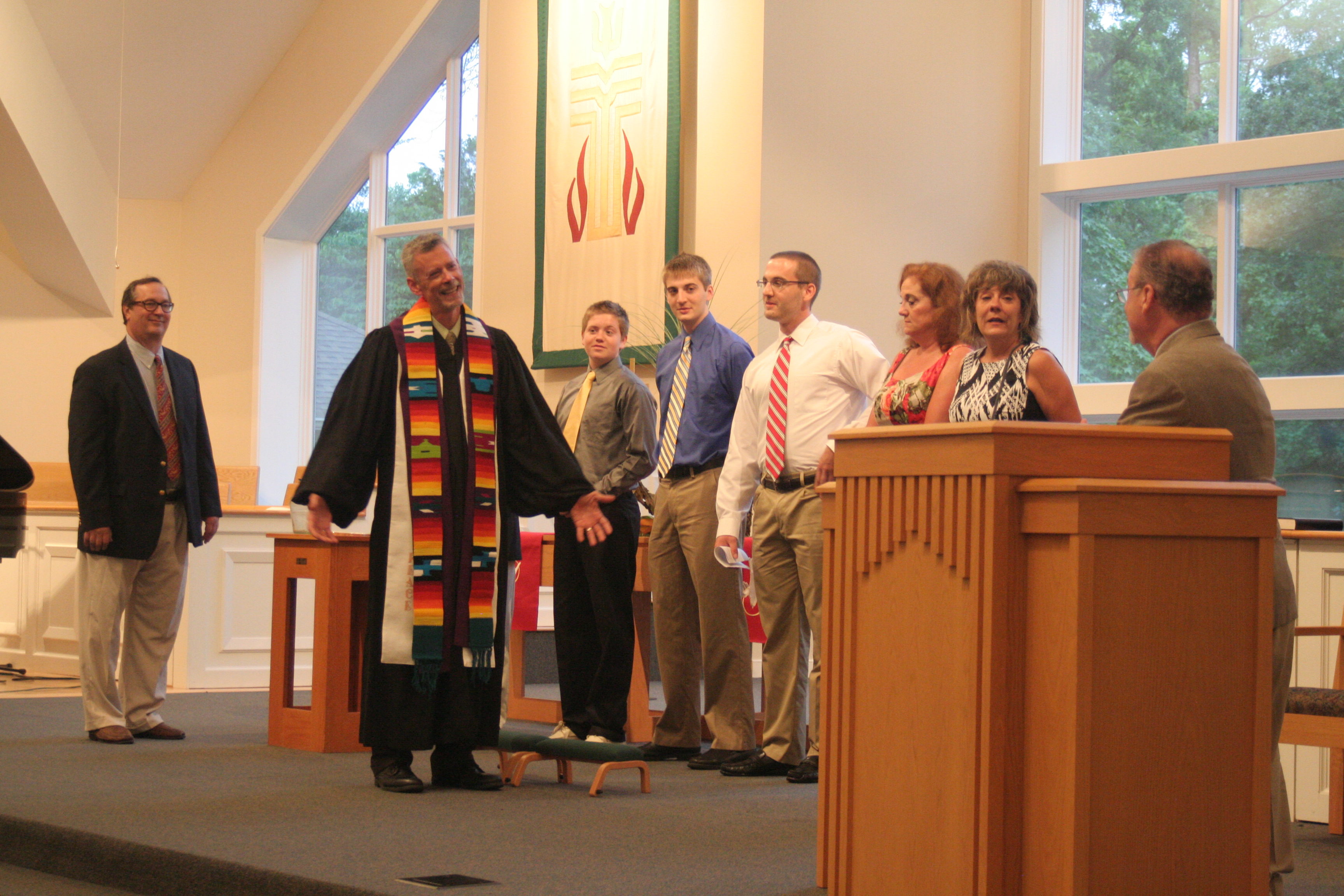
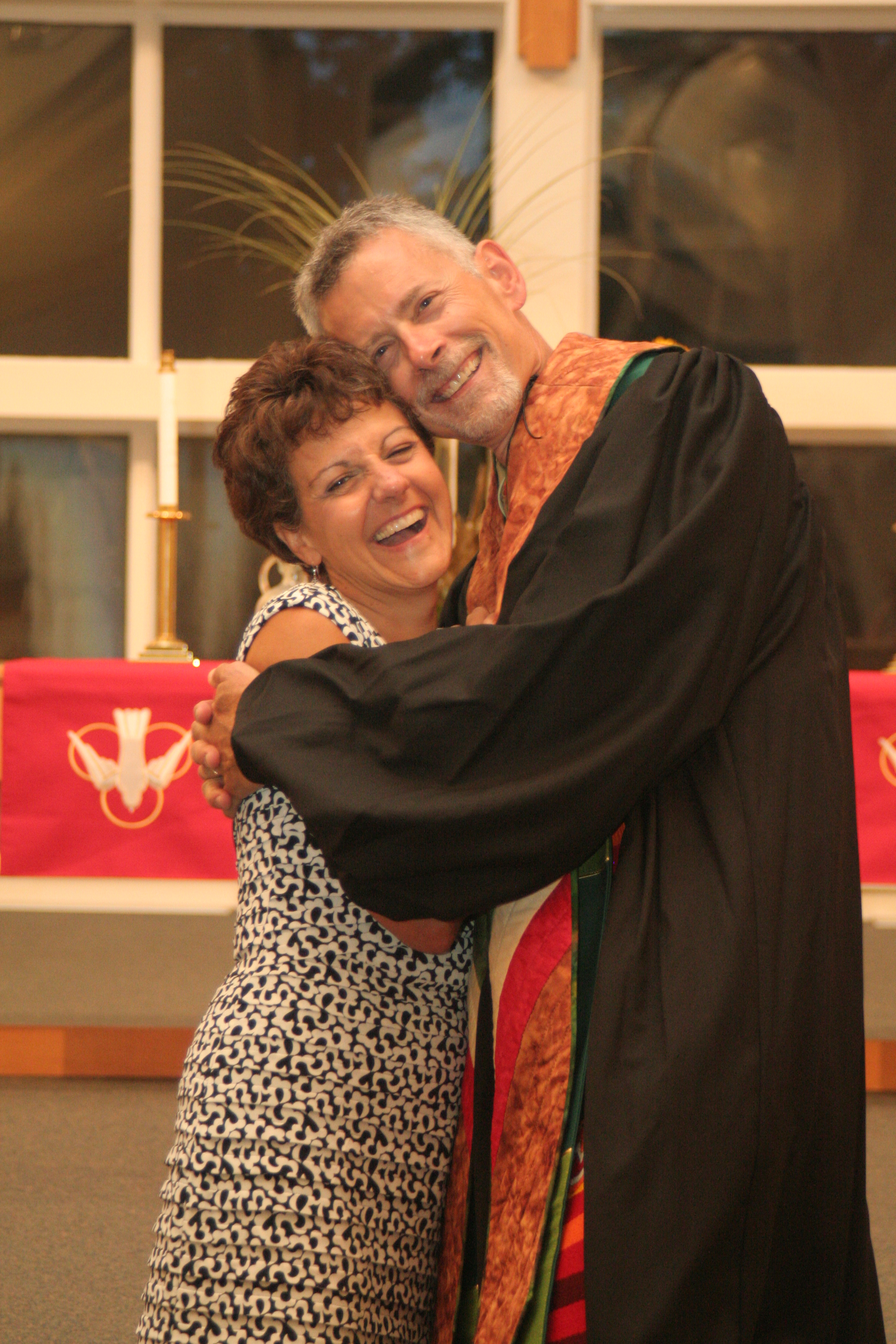
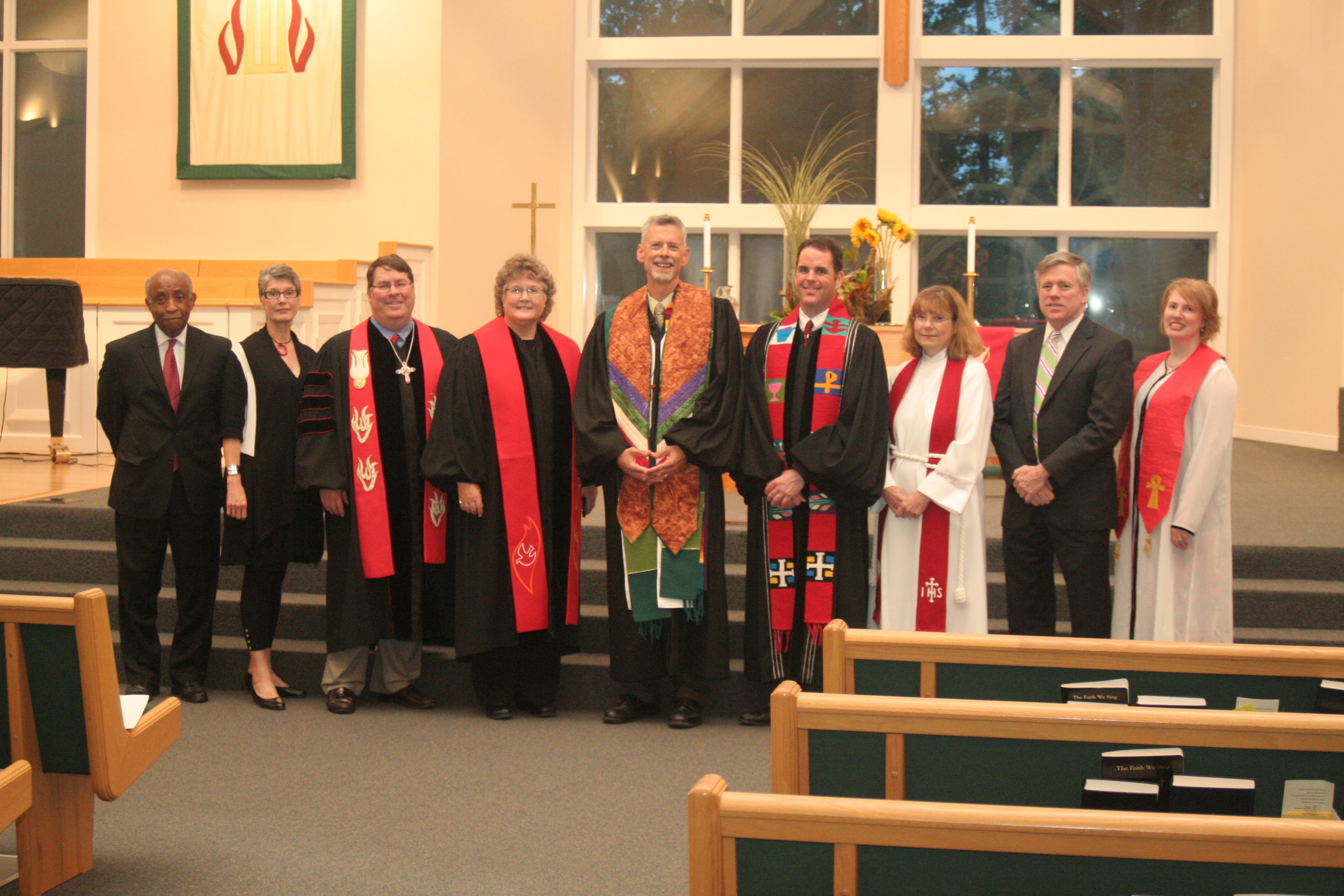
On Tuesday July 2nd, Michael was ordained as a teaching elder (i.e. Minister), in the Presbyterian Church, USA. The service was held at 7:00 in the evening at Michael and Tracie’s home church in Richmond Virginia. Around 80 people were in attendance, including family and many of their close friends. As a new minister, Michael received a Robe, several stoles, a hand-made mahogany cross, and a hand-made communion set. Michael’s road to ordination began in the Fall of 2007 when he entered seminary at Union Presbyterian Seminary in Richmond. After graduation in May of 2012 he completed a chaplain residency in San Diego California at Sharp Memorial Hospital. The road (via American Airlines J) has currently led to St Croix, where Michael and Tracie are excited to be living, working, and serving with the awesome people at St Croix Reformed!

Just One Thing
Remember the movie “The Jerk” with Steve Martin? I loved the scene towards the end of the movie when his character Navin, after losing it all and hitting rock bottom declares to Bernadette Peters, “all I need is this lamp and that’s all I need . . . and this cup. All I need is this cup, this lamp, and that’s all I need . . . and this paddleball game, and that’s all I need! LOL! Come join us this Sunday as we look at what Jesus has to say about the one thing we need as we explore Lukes story of the sisters Mary and Martha. See you Sunday!
Giving back and planting trees

Planting trees to replace the ones cut down that were affecting the wind turnbine
“Community 101” – June 2, 2013
“Community 101” – Sermon June 2, 2013
Luke 7:1-10
“Let the words of my mouth . . . “
Welcome to Ordinary Time! We are now back in the season of the church calendar that is commonly called “Ordinary Time”. Not the same fanfare as Easter with the “Hallelujah Chorus” or Pentecost with “Come Holy Spirit”. Sounds a bit on the dull side doesn’t it . . . “ordinary”. You can almost hear Eyore’s voice in it. “Hey Eyore, how’s it going”. “Nothing out of the ordinary”. Actually, with no specific name, the Sundays are just marked with “numbers” therefore, it’s ordinal or ordinary. You might here “9th Sunday in Ordinary time or 2nd Sunday after Pentecost”.
It’s the season where the primary color in the church becomes GREEN; not because it’s summer in the northern hemisphere but rather that Green is the color that represents growth, so the theme during “ordinary time” is growth. How do we on this side of Pentecost, empowered by the Holy Spirit, continue to grow and develop in our Christian Faith and discipleship? It’s a long season, kind of like Hurricane Season here on the Island, that will go from now until December when the church calendar starts over again with Advent. And while the time will be marked as Ordinary, we know that we live in a world that is nothing but ordinary and this was especially true in our scripture lessons this morning.
In Paul’s letter to the churches in Galatia, his newly founded church was struggling. We hear this loud and clear when Paul forgoes the usual long rhetoric of his letter introductions and at verse 6 notes, “I am astonished”. He will go on with the rest of the letter working to further refine and define the Gospel of Christ for these new church communities so that they can grow in the grace and freedom of Christ.
In Luke’s letter, the struggles with his community might be more subtle but they are still just as challenging as Paul’s. To set the stage, while there is not 100% consensus, most scholars will put the writing of Luke’s gospel somewhere in the neighborhood of 85 AD. This would put it about 15 years after the sacking of Jerusalem and the destruction of the 2nd temple by the Romans in the year 70. Since less than a generation had passed, I am sure that these events were still quite present in their collective memories.
His community would have been very diverse. You would have had Jewish Christians (Christians with Jewish roots); Christian Jews (Jewish Christians still attached to Judaism) and all others that we commonly call Gentiles. Because of certain themes in Luke, many think that, in the standard of that day, it was probably a fairly wealthy community. So, what were they struggling with? Probably a lot of the same things that we struggle with, but one thing in particular was how to be a community. Not just any community, but a diverse community seeking to live out what had been revealed to them in the life and teachings of Jesus Christ..
With that as a backdrop, I think it is helpful to both see and hear how Luke stages today’s lesson. In the last half of Chapter 6 we get Luke’s “Sermon on the Plain” which is similar to Matthew’s “Sermon on the Mount”. Here is where Jesus challenges us to “love our enemies and to do good to those who hate us”. And “If you just love those who love you, what good is that”. Hard words to live out. So what does Luke do . . . he shows them being lived out!
Chapter 7, Verse 1 and 2 . . . “After Jesus had finished all his sayings in the hearing of the people, he entered Capernaum. A centurion there had a slave, whom he valued highly and who was ill and close to death“. Whoa! Wait a minute! A centurion!
Now, when my ears first hear centurion, I must confess that I first think of John Wayne. Does anyone remember the scene in “The Greatest Story Ever Told” where at the crucifixion, John Wayne, playing a Roman Soldier, looks up and says, “truly, this man was the Son of God”? I also think of Russell Crowe in “The Gladiator” all buff and sweaty and strong. Listen to a 5th century description: “a centurion is chosen for great strength and tall stature, as a man who hurls spears and javelins skillfully and strongly . . . he is alert, sober, and agile, and more ready to do the things ordered of him than speak.”
So while the Russell Crowe imagery fits (and maybe John Wayne too), they have also been described as “not to brainy and often abusive of the citizenry”. I’m sure that Luke’s audience is thinking that this guy represents all that is wrong with their country. They shut down our revolution; they destroyed our temple; they are messing up our economy; they are ruining our kids; they personify everything that is bad; in a nutshell . . . they are “the enemy”.
But Luke turns this upside down. Here is a centurion, an enemy occupier, who; is seeking out Jesus to help another AND the Jews are helping AND Jesus is going to go to him. WOW. I did not see that coming. What the heck is going on here? You mean that we need to “really” love our enemies? I did not think that you meant that guy over there. Maybe I could love some of my enemies, but not THAT person. All of a sudden, this centurion is seen, not as ruthless and heartless, but as human. Not as an outsider, but one inside the community. A person of great faith.
In verse 4 we read that the Jews in the community found this centurion “worthy” and even though he declared that he was not so, Jesus affirmed it. He was worthy. So I wonder, who do we look at this way? Who in our society do we exclude from “our community” based on old stereotypes. They don’t look like us or talk like us or maybe share all our beliefs. We accuse them for causing all of the problems of today. According to Luke, loving your enemies means looking past those stereotypes and inviting them in. That’s what the Jews in this story did. And they did more than that, they spoke up for another.
The centurion spoke up for his slave. Now, to our 21st century ears, this word slave can be a challenge for us. The issue of slavery and the Bible is one of those “elephants in the room” that we don’t want to talk about, but there it is. It’s hard for us because we are not that far removed from the hurt, pain, and injustices that came from the practice of slavery. Now while it is true that slavery in Biblical times was different, I am not about to gloss over it and call it something that it is not . . . the centurion had a slave . . . plain and simple.
Our text said that he was “valued highly” which some scholars feel could have been related more to economics than actual feelings. But, that word in Greek is probably better translated “esteemed” or “honored” or “precious”. I like, “he had a slave who was very dear to him”. He was special . . . BUT . . . he was a slave and so the point we need to focus on is that he had no voice. So the centurion speaks for him. And as we read, the centurion does not speak alone.
I think I probably read this passage over two or three times before it hit me that the centurion never actually speaks to Jesus. In Matthew’s version of this story, the centurion and Jesus have a one on one encounter. But not so with Luke. Why. Why did Luke tell the story this way? I believe that it was to show his community and ultimately us, that this is what community does. It speaks out for the other who has no voice.
And in this story, we have two extremes. We have a slave, a marginalized one, who has no voice. And we have a centurion, one who can speak and people do what he commands. When he says go, people say where; when he says jump, those in his command ask how high. Yet, Luke shows us that BOTH have a need for the community to speak for them.
Community means that we don’t have to go it alone. What can be hard about this is that at times, we have to ask for help. And speaking as a man, this can be difficult. I personally am not one who will ask for directions and I am not one who always seeks the advice and counsel of others. We are taught, and I think especially MEN are taught, that we can “pull ourselves up by our bootstraps” or that “God helps those who help themselves”. And while these sayings are not bad, in and of themselves, we are not meant to go it alone. Our faith, while personal, is more than personal, it’s communal. That message is clear from Luke’s story.
But it is scary to ask. It shows a vulnerability that can be very frightening. We think that it shows us as weak; that we will beholden to another for their generosity. But true faith is lived, not in our solitary world, but in the community of others.
When our faith is enacted on behalf of another, it celebrates our web of human connectedness, especially in times of illness and tragedy. This is the imperative of faith living in the world. Today’s story ends with the servant being healed. But I think for Luke it was more than this. It was about his community being on the road to healing. Healed from stereotypes about other people; healed of not reaching out to those with no voice; healed of not asking for help. In a few moments, we are going to gather at the Lord’s Table. Here we will remember the ultimate sacrifice that Jesus made for us and at the same time we will also share in communion with each other. And the question that we need to ask ourselves is . . . who is at this table with us? Who might be missing? Who should we be reaching out too? Who needs me to speak for them? Does someone need to speak for me? Friends, this is community. This IS the Body of Christ . . . Thanks be to God!
Let us pray:
Almighty God, grant that the words we have heard this day
may, through your grace, be so grafted within our hearts
that they may bring forth in us the fruits of the Spirit,
to the honor and praise of your name;
through Jesus Christ our Lord.
Amen.

 St Croix Reformed Church
You must be logged in to post a comment.