Category Archives: Worship

Click here to view worship announcements

Advent Devotions

advent devotions

Psalm 96

By Ricardo Velázquez

During World War I, accounts say a spontaneous truce happened in the trenches between German and British troops when soldiers from each side took turns singing Christmas carols. When the British began to sing “O Come, All Ye Faithful,” the German troops joined them in a chorus heard through the night on that “peaceful” battlefield. It is such power that makes the songs of Christmas so great, and we enjoy them because they are among the most recognizable songs in the world—songs that tell and reflect the spirit of the season. They share with the world the message of peace on earth through the birth of Jesus.

Songs have a powerful way of uniting people through compelling messages and the feelings they evoke. They offer such a unique expression of personal stories and experiences. Knowing this, the psalmist asks us not to just sing songs we know, but to sing a new song too! Though not all of us are gifted with musical talent, our experiences with our Savior need to be expressed and shared with all the earth. The message that tells of his salvation is needed still. All the nations need to hear of his marvelous works among all the peoples. Our songs need to share the value we give our Savior, through our praise, our trust, our offerings, and our worship of him.

This season, let’s enjoy our wonderful, traditional carols, but also actively share and express our newest stories of God to a world that needs joy, peace, and goodwill for more than just a season, with new songs of our daily life in him!

Prayer: God of the ages, sometimes you build on the old, and sometimes you do something totally new. May our songs this season capture the joy of both what you have done and what you are doing!

Ricardo Velázquez supports leadership development for the RCA and works with Hispanic church planters. The 2016 Advent devotions were written by RCA church planters and parent churches.

The Advent devotions follow the Common Lectionary texts. You may use the devotions in a number of ways, but you are encouraged to do the following:

  1. Read the passage through at least once. (Each devotion includes a link to the Scripture passage for the day.)
  2. Reflect on the passage and pay attention to how God might be using it to speak to you.
  3. Read and consider the devotion.
  4. End in prayer. You may begin with the prayer offered at the end of each devotion or pray your own prayer.

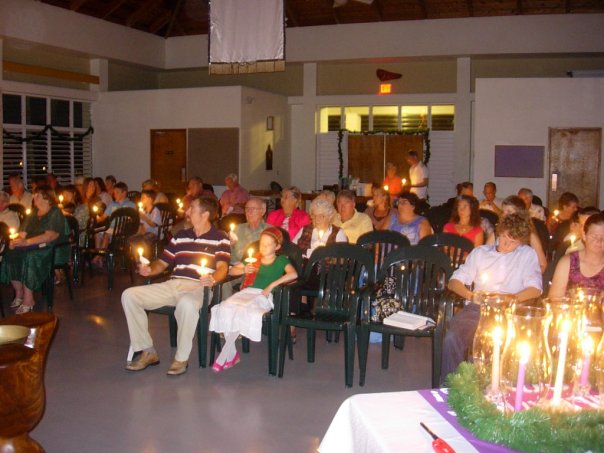
Join us for Christmas Eve Carols and Lessons Candle Light Service at 5:30pm

Puerto Rico 2012 045

Elizabeth Pitcairn returns to St Croix. She will be performing at the St Croix Reformed Church on Saturday, January 14th at 5:30pm

Saturday, January 14th  5:30pm

Doors open at 5:00pm.  Suggested $20 donation


Advent Devotions

advent devotions

Isaiah 62:6-12

By Tom Elenbaas

All around the world, people commute to work or manage daily living in communities aching for grace.

In this passage, I hear promises that cause my heart to ache, longing for a harvest of grain, for ripe grapes to become new wine, and for a level path with boulders removed to make safe passage possible. We long to raise the festival banner, turn up the music, and sing, shout, and dance! But our mouths are dry, our tongues caked in the dust of drought. We see only cracked earth and fields parched, brown with death. We stumble through crooked pathways in the darkness.

“Listen,” it seems Isaiah is saying to those shouting from the walls. “Cry out—without quitting—and do not let the God of goodness sleep through your pain. Remind God of the promises he made to you—of new wine, new grain, and new grapes in the splendor of his house.”

This is an invitation into a new reality despite the difficulty of the day. Whether we are brick-makers in the baking sun of Egypt or sons and daughters slaving today in a consumer culture of our own appetites, here is the promise of a new city. One translation says, “Pass through, pass through the gates!” (NIV), while another says, “Go out through your gates … Go out! Prepare the way for the rest of your people to return!” (NIRV). Both are true. There is an invitation to us to both enter the gates of gladness from wherever we are in the kingdoms of emptiness and to go out, removing boulders and obstacles for others, raising a banner that proclaims, “This is the place of life!” Come, Lord Jesus. Come, Savior. Come, Redeemer, so that we will be called “Sought After” and “the City No Longer Deserted” (v. 12, NIV).

Prayer: God of promise, keep your promises to us who are waiting and longing for your coming again!

Tom Elenbaas is senior pastor of Harbor Churches in Hudsonville, Michigan. The 2016 Advent devotions were written by RCA church planters and parent churches.

The Advent devotions follow the Common Lectionary texts. You may use the devotions in a number of ways, but you are encouraged to do the following:

  1. Read the passage through at least once. (Each devotion includes a link to the Scripture passage for the day.)
  2. Reflect on the passage and pay attention to how God might be using it to speak to you.
  3. Read and consider the devotion.
  4. End in prayer. You may begin with the prayer offered at the end of each devotion or pray your own prayer.

Advent Devotions

advent devotions

Matthew 1:18-25

By Ed Schneider

Joseph is righteous. That’s the foundation of this passage.

The word “righteous” was used with great intention by the writer. Being called righteous wasn’t simply synonymous with being some nice guy who had demonstrated good moral clarity. From a biblical perspective it was far more. This term designated people who by their wisdom, stature, and presentation were mature and firm representations of what God calls the obediently faithful to be. Joseph represented the embodiment of godliness.

Joseph, being a just man, was not willing to disgrace both Mary and her family. Humanly speaking, he had every right to be angry and frustrated by the circumstance Mary had presented to him. Mary and her family were under a cultural contract of sorts. She had broken the terms of her engagement and was soon to be exposed. Yet Joseph couldn’t see the value in causing more damage. So what was he supposed to do?

God showed him what to do by opening Joseph’s eyes and heart to a greater understanding of God’s immeasurable grace.

The Scriptures clearly testify that Mary had been intentionally touched by the Divine. God is dramatically declaring that anyone or anything that the Divine touches in any way becomes both blessed and also a profound blessing to others, regardless of what current culture may demand or argue.

Joseph was called to bring Mary completely into his life and to openly celebrate her life, even if it did not fit neatly into the accepted norms of current culture.

Just like Joseph, when God calls, we are to welcome and receive the people who make us uncomfortable or who seem unclean, so that they may experience through us the practical display of God’s love and subsequent empowerment.

Just like Joseph, we are called to move beyond what we already know to fully experience what God has in store.

Prayer: God of grace, give us a fresh understanding of the way your grace operated toward and between Joseph and Mary. Help us live into such immeasurable kindness and patience, even if the culture around us condemns.

Ed Schneider is the Fresh Start pastor of Trinity Community Church in Kent, Washington. The 2016 Advent devotions were written by RCA church planters and parent churches.

The Advent devotions follow the Common Lectionary texts. You may use the devotions in a number of ways, but you are encouraged to do the following:

  1. Read the passage through at least once. (Each devotion includes a link to the Scripture passage for the day.)
  2. Reflect on the passage and pay attention to how God might be using it to speak to you.
  3. Read and consider the devotion.
  4. End in prayer. You may begin with the prayer offered at the end of each devotion or pray your own prayer.

Advent Devotions

advent devotions

Romans 1:5-7

By Andrea DeWard

The beloved church that was home from cradle to college invited me to preach Thanksgiving through Christmas. What a joy and honor to be welcomed as a daughter of the church. Decades of grand worship gatherings on holiday mornings are preserved as idyllic snapshots in my mental scrapbook:

Friendly deacons stationed to greet and pass out bulletins. Young parents ushered into the sanctuary, holding newborns and toddlers. Red-cushioned pews filled from front row to balcony. Hymns sung by heart in four-part harmony. Worshipers of all ages and stages gladdened and grateful for God’s good gifts—provision at Thanksgiving, baby Jesus at Christmas, resurrected life at Easter.

My mind memorializes these scenes of familiarity and belonging as if Hallmark scripted a “home for the holidays” movie. Peppermint-sticky children grin as grandparents sneak them another treat. College students gulp down cookies and punch in between welcome home hugs. No one remains anonymous. My faith community of the 1980s and 1990s was a place “where everybody knows your name” and even the out-of-town boyfriend and the visiting sister-in-law were considered honorary members.

You belong to the church. You belong.

It’s a lovely picture. Yet the experience and expression of the people of God is more than idealized images of a cheery church family. The full message and meaning of God’s love and calling cannot be conveyed by an annual greeting card. In Advent, we consider the significance of God made flesh in Jesus, coming to be like us so we would come to be like him. We wait for grace delivered in person, gifting faith far richer than any purchased present wrapped in bright bow. The Word will arrive with newborn lungs to announce a new birth, a born-again birth into a new family, a holy people:

“Through him we received grace and apostleship to call all the Gentiles to the obedience that comes from faith for his name’s sake. And you also are among those Gentiles who are called to belong to Jesus Christ. To all in Rome who are loved by God and called to be his holy people: Grace and peace to you from God our Father and from the Lord Jesus Christ.” (Romans 1:5-7, NIV)

You are called to belong to Jesus Christ. You belong.

I spent 21 years at that first home church, followed by 18 years of church ministry. This year, however, our family hasn’t had a church home. It’s the first significant period in our lives without a set place to be every Sunday. Romans 1:5-7 reminds me that we belong to Jesus, we are loved by God, and we are part of God’s holy people. But we do not belong to a particular church family right now. Instead, we’ve taken the opportunity since January to experience a breadth of church ministries from our unique dual vantage point as pastors-turned-guests.

After nearly a year of checking the visitor box, I’m looking forward to being “home for the holidays.” This season, when I return to the church of my youth and look around at the people of God gathered in that place, I’m sure I will marvel at newborns held in their mothers’ arms and wonder how those once-young girls fast-forwarded into parenthood. Likewise, I’m sure people who remember me as a young girl will marvel, “Your daughter looks just like you!” and wonder how my toddlers turned so quickly to teens. We’ll nestle into a pew with grandparents and we will be welcomed and embraced.

You belong to the church. You belong.

I’m grateful to have a place to call home for a brief bit. But I’m increasingly aware that my lifelong experience of joyful church gatherings is not the experience of many. For some, it is painfully clear they have been excluded from full belonging among those called to be the people of God. And so I go into this season with deeper questions on my mind. The Word made flesh comes to speak grace and peace, but do we? And by “we,” I mean we who have “received grace” and claim the title “holy people.” Are we inviting others, including those who seem very different from us, to belong? Instead of my sentimental holiday vision, imagine this scene at worship at my childhood church on Christmas morning:

The church of old “where everybody knows your name” has many new faces. The weary parents are an interracial couple with biracial children. The kids chomping peppermints have ADHD and autism. The grandpa has alcohol on his breath. The college student looks depressed and anorexic. The out-of-town boyfriend is Palestinian. The visiting sister-in-law is accompanied by her wife. The young mother is in fact still a teenager. And the preacher is a woman. Then there’s Jesus in the midst of them all.

You are called to belong to Jesus Christ. You belong.

Will we learn their names? Will we embrace them? Will we speak grace and peace like Jesus does? In this Advent season, we live in expectation of the Christ child, the One who lights our way in the darkness. As we prepare to receive him, to receive grace anew, may we also become ready to call each person near and far to receive this abundant gift of grace offered to all, with hospitable words and intentional deeds.

You also are called, you also belong, and you are loved. Grace and peace.

Prayer: God and Father of this wild, beautiful family, give us a new love during this season for our brothers and sisters, near and far. You have been gracious and invitational; give us hearts to do likewise.

Andrea DeWard, a former church planter, serves on the executive team of Great Lakes City Classis and helps churches in transition. The 2016 Advent devotions were written by RCA church planters and parent churches.

The Advent devotions follow the Common Lectionary texts. You may use the devotions in a number of ways, but you are encouraged to do the following:

  1. Read the passage through at least once. (Each devotion includes a link to the Scripture passage for the day.)
  2. Reflect on the passage and pay attention to how God might be using it to speak to you.
  3. Read and consider the devotion.
  4. End in prayer. You may begin with the prayer offered at the end of each devotion or pray your own prayer.

Advent Devotions

advent devotions

Romans 1:1-4

By Tim Vink

Christmas is full of new things. Every gift I’ve seen unwrapped from under a Christmas tree for decades is a new thing. Retailers love it, and for shipping companies this is the busiest season of the year.

The apostle Paul opens his letter to the church in Rome talking about the greatest gift of all time, God’s gospel. God is the greatest giver ever, and when God wanted to communicate this love, he wrapped up the gospel in the person of Jesus Christ our Lord.

Six hinges of history in God’s gospel are the pivot points for all people in all places and at all times: the birth and life of Jesus, his death, his resurrection, his ascension, the pouring out of the Holy Spirit through Jesus at Pentecost, and Christ’s second coming. Paul, who was an expert on the Old Testament, knew of the more than 300 prophecies fulfilled in real time by Jesus spanning these six essentials of the gospel.

So what is the stunningly new thing in this gift of God wrapped up in the person of Jesus? He “was declared to be the Son of God with power by his resurrection from the dead” (v. 4). Jesus did not just come back to ordinary life, amazing as resurrection was for him and others whom he raised. Instead, he is the first human resurrected to eternal living, the first of a new kind of existence sure to come for all who believe now, the evidence of the new heavens and new earth to come when he returns. This is new creation evidence before our very eyes.

Jesus is seen and touched in his resurrected status for 40 days on earth, by as many as 500 people at a time, says 1 Corinthians 15. Just 15 minutes of eyewitness testimony from each one who interacted with Jesus during those days would have a courtroom filled for five days and nights, nonstop.

The new thing God is doing at this pivotal point in history is tying the “already” (Jesus’ resurrection) to the “not yet” (new heavens and earth when the kingdom of God is fully realized). The resurrection of Jesus already demonstrates that the kingdom of God is at hand—how much more so will the complete change to the whole of heaven and earth demonstrate the explosion of power released in Jesus’ resurrection. This new creation will require the greatest power known to this universe so far, even greater than the first creation itself. Keep unwrapping that gift—forever!

Prayer: Mighty God of creation and re-creation, we see your awesome power displayed from the beginning of the story, through the middle, and all the way to end. Thank you for the great gift of gospel in the birth, life, death, resurrection, and return of King Jesus!

Tim Vink works with church planters and parent churches across the RCA as senior Church Multiplication catalyst. The 2016 Advent devotions were written by RCA church planters and parent churches.

The Advent devotions follow the Common Lectionary texts. You may use the devotions in a number of ways, but you are encouraged to do the following:

  1. Read the passage through at least once. (Each devotion includes a link to the Scripture passage for the day.)
  2. Reflect on the passage and pay attention to how God might be using it to speak to you.
  3. Read and consider the devotion.
  4. End in prayer. You may begin with the prayer offered at the end of each devotion or pray your own prayer.

Advent Devotions

advent devotions

Psalm 80:17-19

By Bob Bouwer

Psalm 80 finds Israel divided into twelve tribes and two kingdoms. Each had its own leaders, values, and theological differences.

This has parallels with the worldwide Christian church, which consists of “tribes” of various denominations and two large “kingdoms”—Protestant and Catholic. This division continues among conservatives and liberals, traditional- and contemporary-music fans, and people who prefer high liturgy and people who prefer low liturgy.

Our text today speaks words of hope to the church worldwide and to our particular denominational context in three ways. The first is that God’s hand is on the one at his right hand, the Son of Man. This points to Jesus the Messiah and to Israel, God’s firstborn. These words remind us that God has called Israel to be one nation, one people. Under Christ Jesus, there is unity, and he is Lord over all.

The second way it speaks to us is by showing us how we should respond. We must not turn our backs on God’s Word but rather be proactive, seeking life in him and praying. These actions allow us to see God’s will for our lives.

The third way it speaks to us is by giving us hope of restoration or transformation. We turn away from God’s Word, but God can bring us back, providing grace to save us. Asking God to turn us around by his grace, mercy, and strength brings unity in diversity.

I appreciate the explanation Michael Wilcock offers in his commentary, The Message of Psalms 73-150: Songs for the People of God. He writes: “We may have the deepest misgivings about some who reckon themselves God’s people. We may deplore some of their belief and practices that flourish under the name of the church of Christ. But wherever the inheritance of biblical truth may still be found, there is the one ‘Israel of God’ and we must pray for ‘peace and mercy to all who follow this rule.’”

Prayer: God, only you could understand the unity of such a diverse body of believers. You see more than we do; you know more than we do. Help us to do our part and to pray lovingly for peace and mercy on all who follow your rule.

Bob Bouwer is pastor of Faith Reformed Church in Dyer, Indiana. The 2016 Advent devotions were written by RCA church planters and parent churches.

The Advent devotions follow the Common Lectionary texts. You may use the devotions in a number of ways, but you are encouraged to do the following:

  1. Read the passage through at least once. (Each devotion includes a link to the Scripture passage for the day.)
  2. Reflect on the passage and pay attention to how God might be using it to speak to you.
  3. Read and consider the devotion.
  4. End in prayer. You may begin with the prayer offered at the end of each devotion or pray your own prayer.

Advent Devotions

advent devotions

Psalm 80:1-7

By Scott DeLeeuw

At times in our Christian lives we feel as though we are exiles, a people who belong somewhere else, a people uncomfortably placed in the middle ground between God’s saving action and a world hostile to it. We struggle to maintain our identity and capacity for hope, relying mostly on our own strength to sustain us while searching incessantly for some sort of relief. All the while, we become increasingly frustrated, tired, and discouraged because it seems as though God has left us just hanging there in that middle ground.

These emotions drive us to a place of questioning God and his action—or what at times appears to be inaction. And so we speak in honest and sometimes dangerous ways, letting God know where we stand and how deep our distress really is, yet we know where our relief and restoration will ultimately come from. And we pray and lament, acknowledging that God is available to us and real in ways that make a difference in our lives right now, giving us hope and increasing our faith and reliance on him.

In the first two verses, the psalmist prays, calling out to the Shepherd King of Israel to listen and to use his mighty power to bring about relief. What follows is key. The psalmist cries out, “Restore us, O God,” calling on God to bring relief, to revive them from the point of death, and to bring about a return from exile. A return that restores their lives in real and present ways by shining light into their darkest situations. In the final four verses, the complaint is leveled again, with restoration at the core of this plea as well—relief for those in the uncomfortable middle ground between God’s saving action and a lost, broken world.

Advent focuses our attention and prayers on the One who’s coming, the One who brings relief, the One who revives, and the One who brings life to those on the brink of death. This is the good news.

Prayer: Shepherd King, when we struggle in the space between wreckage and redemption, hear our prayers and our laments. Give us hope and increase our faith and reliance on you.

Scott DeLeeuw is pastor of Ekklesia Church Oceanside in Oceanside, California. The 2016 Advent devotions were written by RCA church planters and parent churches.

The Advent devotions follow the Common Lectionary texts. You may use the devotions in a number of ways, but you are encouraged to do the following:

  1. Read the passage through at least once. (Each devotion includes a link to the Scripture passage for the day.)
  2. Reflect on the passage and pay attention to how God might be using it to speak to you.
  3. Read and consider the devotion.
  4. End in prayer. You may begin with the prayer offered at the end of each devotion or pray your own prayer.

Advent Devotions

advent devotions

Isaiah 7:10-16

By Prince Couisnard Sr.

Ahaz is troubled because the enemy has plans to take over his land and set up a new king in his place. God’s immediate response is something we can cherish as believers: he sends Ahaz a messenger, Isaiah. Thus God personally reveals to Ahaz that he knows the details of his problems and encourages him not to be concerned. God gives him personal words to “take heed, be quiet, fear not, and do not let your heart be faint” (v. 4).

Along with Ahaz, all believers must realize afresh that our God is with us. We must evaluate every battle that the enemy brings with one thing in mind—that we can trust God! We are a part of an eternal plan to establish his kingdom here on earth. We should heed the warning that God clearly communicated to Ahaz, “If you do not stand firm in faith, you shall not stand at all” (v. 9).

The fact that God is always present in advancing his kingdom is surely revealed in his answer to Ahaz. The sign was to be a boy named Emmanuel—God with us! This Advent was determined before the foundations of the world.

My wife and I have been surrounded by threats in our inner city ministry. We have lost many battles, but we know through Christ that we will win the war. We thank God for his promise that he is not only in us but also with us!

I encourage you to meditate on this announcement too as you journey through Advent. Ask God to fully reveal what this sign means to you and the kingdom, so that you can share its powerful message with family and friends this season.

Prayer: In the midst of threats that invade our hearts, you provide, God who is with us and for us. Thank you for coming to us.

Prince Couisnard Sr. is pastor of Christ the Redeemer in Houston, Texas. The 2016 Advent devotions were written by RCA church planters and parent churches.

The Advent devotions follow the Common Lectionary texts. You may use the devotions in a number of ways, but you are encouraged to do the following:

  1. Read the passage through at least once. (Each devotion includes a link to the Scripture passage for the day.)
  2. Reflect on the passage and pay attention to how God might be using it to speak to you.
  3. Read and consider the devotion.
  4. End in prayer. You may begin with the prayer offered at the end of each devotion or pray your own prayer.