Author Archives: smcalhoon
Live Nativity
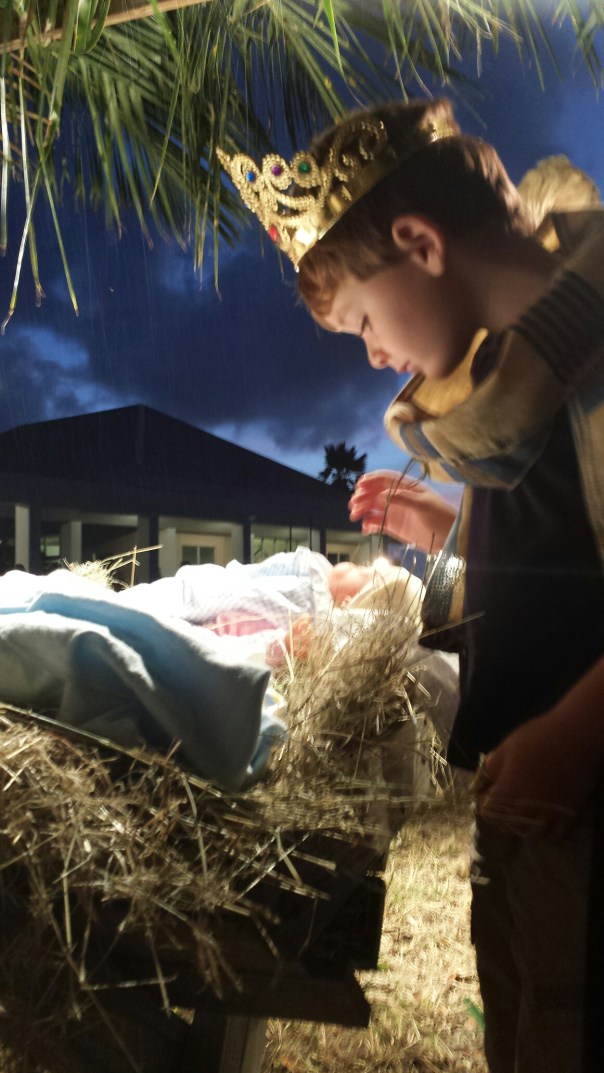
In case you missed our Live Nativity, I think this picture pretty much sums it up…Amazing!
Advent Devotions
|
||||||||||||||||
|


Advent Devotions
Wednesday, December 16
Psalm 80:4-7
Today’s verses follow on the heels of yesterday’s. But today the psalmist’s accusations grow stronger.
It’s not just that God hasn’t been doing what he used to. Now the psalmist charges God with active cruelty—being angry despite the people’s prayers, feeding them with the bread of tears, making them the laughingstock of the neighborhood.
The amazing thing is, though, that the psalmist still turns to God. Though he is frustrated with God and believes God to be the source of Israel’s suffering, he’s also convinced that God will be the source of her salvation. The psalmist knows that Israel exists because God called her into existence. The psalmist knows that he himself is God’s creature and that his restoration will come through God alone.
Are you convinced of that? Are you convinced that God is the source of your salvation, even though the opposite may feel true?
In case you’re not, remember this: “Indeed, God did not send the Son into the world to condemn the world, but in order that the world might be saved through him” (John 3:17). Jesus Christ has come and is already at work restoring his creatures. He wants you to have life, and have it to the full (John 10:10).
Prayer: O God of our salvation, I turn to you for help. In the midst of suffering, it’s hard for me to believe that you also bring salvation. But I want to believe. Help my unbelief. Remind me of your deep love for me, love that you have shown in Jesus Christ.
|


Advent Devotions
Tuesday, December 15
Psalm 80:1-3
Read over the psalm again. Hear the pleading in the psalmist’s voice: Give ear, O Shepherd! Stir up your might and come save us!
The psalmist remembers the days when security seemed easy to come by. All it took was carrying the ark of the covenant and the people of Israel were safe.
The ark of the covenant was a great gold chest topped by two gleaming angels, their wings outstretched to meet each other, marking the space where God dwelled. It housed the Ten Commandments—the covenant between God and Israel. It was not to be touched.
When they traveled through the wilderness, the ark went first, carried on poles by priests. The two cherubim perched upon the ark, indicating God’s presence and protecting God’s people. When the priests carrying the ark stepped into the Jordan River, the river’s current ceased and the people crossed on dry ground (Joshua 3). When Israel’s priests and warriors marched around the city of Jericho with the ark in their midst, the walls collapsed, and Israel captured the city (Joshua 6).
The psalmist cries out to God: You who are enthroned upon the cherubim! Where have you gone? Can you hear us? Do what you used to do: come save us!
Maybe you sense that void in your own life—the God who once seemed so near, who used to go before you and make your future secure, who protected you through your childhood and early adulthood, has seemed to disappear. You feel that you’re on your own.
Follow the psalmist’s lead. Turn to God and ask God to turn to you. Beg him. Seek him.
Prayer: O Shepherd, I’m losing hope. You used to guide me like a sheep from your flock. You used to go before me and smooth my path. Where have you gone? Listen to my cries! Muster up your power and save me! Restore me. Let your face shine.
|
Advent Devotions
|
||||||||||||||||
|
Advent Devotions
|
|
Advent Devotions
|
|
Advent Devotions
Friday, December 11
Luke 3:7-14
Today’s reading brings us back to John. John the Baptizer, John the prophet, John the negative Nancy. He’s always raining on our parade, warning us of some impending doom, calling us names—this time, “brood of vipers.” Gee, thanks, John.
But, as usual, he’s on to something. While we’re busy going about life, frolicking in our sure salvation, John is begging us to remember that the security of our salvation doesn’t get us off the hook. Trees that don’t bear good fruit are cut down and thrown into the fire.
“Bear fruits worthy of repentance,” he tells us. Let’s parse that for a minute. In this case, “worthy of” means something along the lines of “consonant with.” The ESV translation reads, “Bear fruits in keeping with repentance.” Let your fruit arise out of your repentance. If the tree is repentance, the fruit will be good.
Repentance might not be the first virtue that comes to mind during Advent, but it’s a necessary one. How can we prepare our hearts to receive the coming Lord if we’re stocking them with rotten, mealy fruit? We must confess our sin, clear it out, and start to bear good fruit—good fruit like giving to others, taking no more than our share, and being content with what we have.
This is pretty practical fruit here. Take the weekend to choose one of the actions John names and put it into practice in preparation for Christmas.
Prayer: Merciful God, I confess my sin and selfishness to you. Don’t let me get too comfortable. Prune the bad fruit from me and give me the grace to bear good fruit that’s worthy of repentance.
|
Advent Devotions
Thursday, December 10
Philippians 4:4-7
The world into which Jesus was born—and the world in which the apostle Paul wrote—was not a peaceful world. Those days, like ours, held wars and rumors of wars. They held persecution and political maneuvering. It would’ve been tempting to wonder what God was doing, or if he was even paying attention to the plight of his people.
And yet Paul says that the peace of God will guard our hearts and minds. Will it really? How can our hearts possibly be guarded against the onslaught of violence, enmity, strife, disease, and loneliness? How can he instruct us to rejoice?
Because, like the poet Wendell Berry, he’s convinced that the facts of the world don’t have the final say. He’d find a kindred in spirit in Berry, who writes this in his poem, “Manifesto: The Mad Farmer Liberation Front”:
“…Expect the end of the world. Laugh.
Laughter is immeasurable. Be joyful
though you have considered all the facts…”
Be joyful though you have considered all the facts.
It’s true. The facts of the world frequently do not bring joy. But the facts of the gospel give us reason to laugh and to rejoice.
The fact of the gospel is that the Lord is near. The Lord, the sovereign one, is close by. Just when we thought all was lost, God came to make his dwelling with us. And we must expect the end of the world, when the Lord will come near once again—when he will once and for all dwell with us.
That’s why Paul can tell the Philippians to rejoice. That’s why he can reassure them of the bone-deep peace that’s possible. Paul has considered all the facts. And the most prominent of them all is that the Lord is near.
Prayer: Lord who comes near, I will laugh today. I will rejoice because, as I have considered all the facts—the facts of my life, the facts of the world, the facts of your kingdom—the one fact that speaks most loudly is that you are here. Guard my heart against despair and let me feel joy.
|

 St Croix Reformed Church
You must be logged in to post a comment.